George Fitzroy
The Dark ForestGeorge Fitzroy is a United States general, a coordinator at the Planetary Defense Council, and the military liaison to the Hubble II Space Telescope project. His decisive significance lies in the way he occupies the boundary between military urgency and scientific uncertainty. Fitzroy is not simply a commander receiving reports: he repeatedly presses specialists to interpret ambiguous observations, recognizes the strategic meaning hidden in technical details, and helps convert astronomical traces into evidence about the approaching Trisolaran Fleet.
Identity and Institutional Position
Fitzroy holds a senior position within the Planetary Defense Council while also carrying responsibility for nuclear missile defense and liaison work with the Hubble II project. His authority is therefore distributed across institutions that do not naturally speak the same language. Military officers need immediate judgments about threats; astronomers work through delayed observation, specialized instruments, and cautious inference. Fitzroy’s role is to force those forms of knowledge into contact without allowing scientific complexity to dissolve the military stakes.
That position is visible during the missile-defense incident at Fort Greely, Alaska. A buried white hemisphere opens in the snow and launches a flaming cylinder into the sky. At the Nuclear Missile Defense Control Room beneath Cheyenne Mountain, Target Screening Officer Raeder regrets missing the chance to confirm a launch interrupt, while Orbital Monitor Jones dismisses the warning as harmless. Fitzroy asks what the system is attacking. He is new enough to the responsibilities of Nuclear Missile Defense that the displays appear to him as an unintelligible abstract jumble rather than the more intuitive trajectory graphics used at the NASA control center. The scene establishes a general whose authority does not eliminate informational dependence: he must rely on operators who can read patterns invisible to him.
The Hubble II Investigation
Fitzroy’s relationship with Hubble II’s astronomers is marked by impatience, suspicion, and genuine intellectual engagement. At the telescope’s control room, one week after assembly, he demands that the team observe Trisolaris immediately. Albert Ringier explains that this is not possible, and Fitzroy suspects that the astronomers are using the instrument for private work. His suspicion reflects the military demand for direct answers, but it also exposes the institutional friction created when a strategic project depends on observations whose relevance may not be apparent to an outsider.
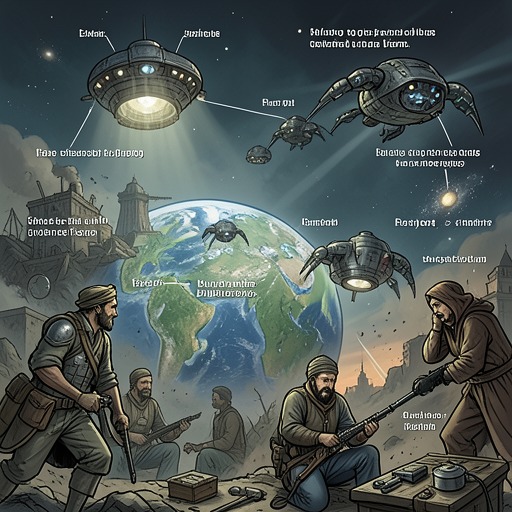
The investigation changes when Ringier explains the astronomical clue. The three stars of Trisolaris are surrounded by interstellar dust. Bodies moving rapidly through that dust have left wakes, and those wakes have expanded to a diameter twice that of Jupiter. At close range the wakes are almost indistinguishable from the surrounding dust, but from a distance of four light-years they become observable. Fitzroy counts approximately a thousand visible “bristles,” and Ringier confirms that the number matches intelligence reports. The observation identifies the distant formation as the Trisolaran Fleet. Fitzroy’s contribution is not the discovery alone but the act of demanding that a visual irregularity be treated as a military fact.
Five years later, Fitzroy has become so familiar with the starfield between Earth and Trisolaris that he can sketch its stellar positions accurately from memory. The three stars at the center appear as one in the standard view, yet magnification reveals that their positions have changed. He watches the fleet’s earlier brush fade and waits for another trace to appear as the fleet crosses interstellar dust clouds. Astronomers call these regions “snow patches,” because the fleet leaves tracks in them like footprints in snow. The fleet’s four-century voyage will intersect five such patches, and Fitzroy understands that the timing of the next passage may disclose more than a spectacle: it may reveal what the fleet has done during the years when Earth could not see it.
His insistence on precision becomes especially important when he asks whether the astronomers can determine the exact date on which the fleet launched its probes. Because the probes were launched in dust, their wakes intersect the fleet’s tracks and allow the event to be dated. When Ringier gives him the date, Fitzroy is momentarily speechless, then lights a cigarette. He tells the scientists that they are not politicians and cannot see why this is crucial. The exchange captures his characteristic mode of reasoning: an observational detail becomes strategically decisive only when placed inside a larger model of intention, timing, and capability.
Strategy, Secrecy, and Credible Threats
Fitzroy’s work unfolds within the logic of the Wallfacer Project. The project arises because the sophons make Earth transparent: they can read human communications, files, computer storage, and every openly formulated plan, while remaining unable to read uncommunicated human thoughts. The Wallfacers therefore construct strategies internally and present false outward behavior, turning deception into humanity’s remaining advantage against an enemy that communicates through direct, open thoughts and is deficient in camouflage and trickery.
This framework gives Fitzroy’s actions a wider significance. His military position depends on information, yet the most valuable information cannot safely be communicated through ordinary institutional channels. The general must work amid systems in which the enemy can see every declared plan while humans struggle to distinguish genuine intention from deliberate misdirection. The result is not simple secrecy but a contest over which signals can be made credible. A proposal involving fighters carrying hundred-megaton-class superbombs, for example, is publicly described as a suicide strike against the Trisolaran Fleet; the Wallbreaker’s exposure of the plan demonstrates how quickly a seemingly coherent strategy can be reduced to its visible shell.
The same strategic logic appears in the technology developed by Wallfacer Rey Diaz. His cradle system does not transmit a detonation command. Instead, it sends a continuous non-detonation signal to Mercury; if the signal is interrupted, the hydrogen bomb detonates. The mechanism is a dead-man’s switch, converting the absence of a signal into an automatic act of destruction. Fitzroy belongs to the institutional world that must evaluate such devices, where a command is not merely an instruction but a commitment whose credibility rests on an irreversible consequence.
From Observation to Civilizational Defense
Fitzroy’s perspective also encompasses the immense material transformation undertaken by humanity. The completion of the space elevator and the breakthrough in controlled fusion encourage the world, but sober leaders understand that these achievements only bring humanity to the seashore: the main spacecraft bodies, space weapons, recirculating ecosystems, and space ports remain to be built. The foundations of a space fleet may take a century, while the resources required for defense threaten to reduce living standards by a hundred years.
This defensive mobilization produces environmental consequences that Fitzroy’s strategic world cannot escape. Heavy industry accelerates while environmental protection is stigmatized as treasonous or associated with the Earth-Trisolaris Organization. Pollution, greenhouse effects, climate anomalies, and desertification contribute to food collapse and eventually the Great Ravine. The strategic project is therefore both necessary and destructive: it seeks to preserve civilization while consuming the ecological and economic conditions that make civilization livable.
The exploration of the Solar System follows the same tension. Human missions to Mars and the moons of Jupiter are organized primarily to establish defensive bases, while the strategic value of the inner planets leads the Planetary Defense Council to approve Rey Diaz’s plan to test the Stellar Hydrogen Bomb on Mercury. The excavation required for the test becomes humanity’s first large-scale engineering project on another planet, but it reaches only one-third of its intended depth before an unusually hard layer of metal and rock makes further work too costly. The failed excavation illustrates the limits that remain beneath the rhetoric of planetary mastery.
The Expanding Meaning of His Knowledge
Later strategic thought moves beyond fleet detection toward the behavior of civilizations. Benevolence is defined in strictly operational terms as not taking the initiative to attack and eradicate another civilization; malice is its opposite. The narrowness of this definition matters because distance and ignorance make intentions impossible to verify. A civilization may detect another without knowing its details, while remaining unaware that the other exists. Fitzroy’s institutional concerns thus open onto the larger problem of incomplete information: defensive action can look like malice, and a threat can become credible only when it risks destroying the world that issues it.
The Snow Project turns this problem into an engineered signal. Stellar hydrogen bombs and Neptune’s oil film are intended to create clouds of space dust through which the droplets will leave visible tracks. In its mature form, the project is tied to a cradle system containing 3,614 bombs in solar orbit. A vital-signs monitor sends a maintenance signal every second; if Luo Ji dies, the signal disappears and all the bombs detonate, transforming their surrounding oil film into 3,614 dust clouds. Their arrangement would make the Sun’s light flicker in the form of three images that encode the location of Trisolaris relative to twenty-nine surrounding stars, while also exposing the positions of the Sun and Earth to observers elsewhere in the galaxy.
Fitzroy’s lasting narrative role is consequently that of the military interpreter of a civilization learning to read the dark. He begins amid missile-defense screens whose patterns he cannot immediately understand and becomes associated with the patient study of a starfield, the counting of distant traces, and the recognition that a date or a faint wake can alter the strategic meaning of an entire war. His knowledge never makes the universe safe. Instead, it reveals how survival depends on converting uncertain signs into credible commitments while accepting that every defense may also become a signal, a weapon, or an invitation to catastrophe.